


Pre-formed packaging versus produce on-demand
Our last piece, beginning Series B - Science of Systems, explored ‘How systems make green protective packaging greener’ ended pondering questions not asked enough about packing peanuts, like where do you actually put them?
Or perhaps you’ve got used to making space for them and say; ‘it’s just the way we’ve already done it’ or ‘well, it sort of works’, or ‘we’ve looked at alternatives but too expensive’.
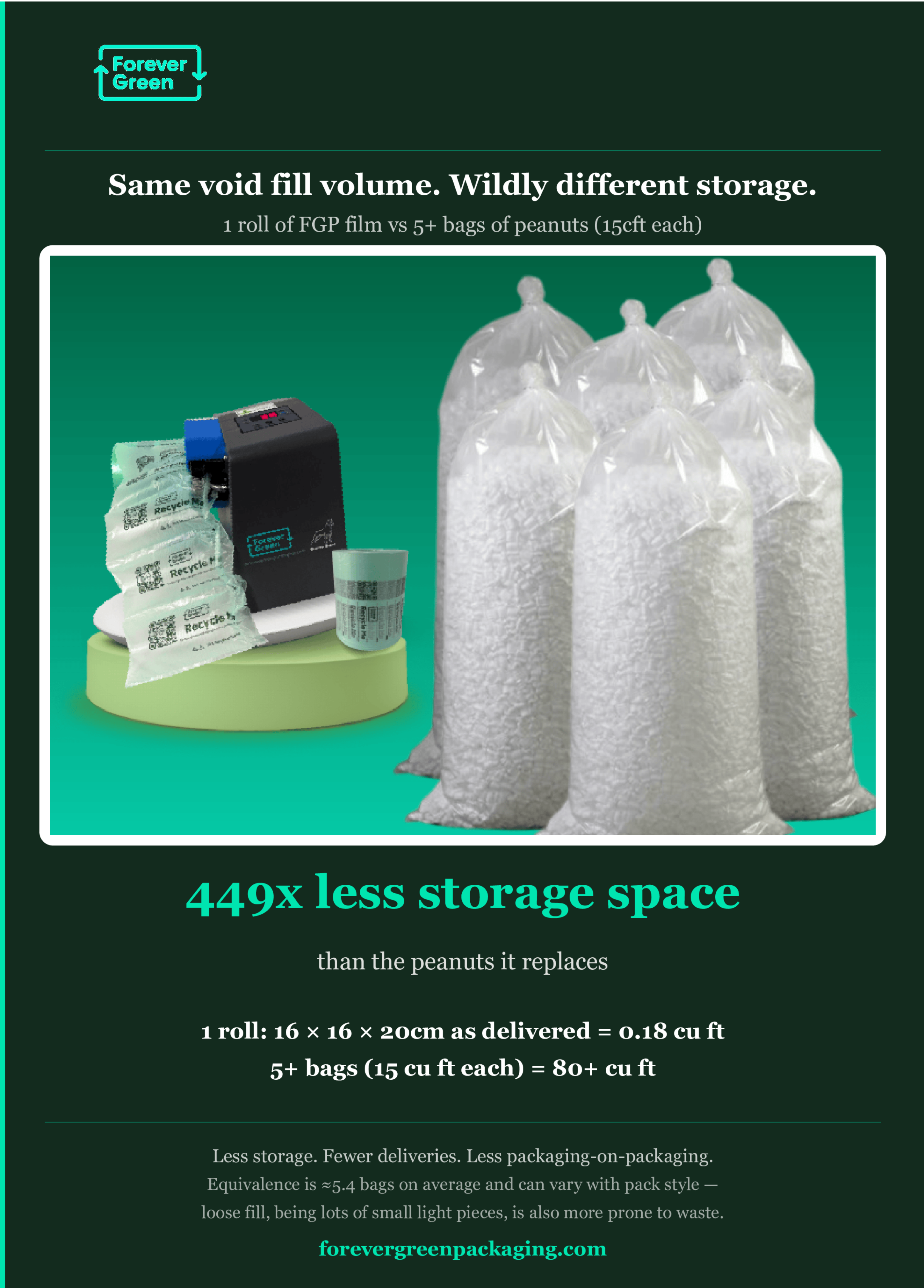
Imagine what better things you can do with the space you’d save from not storing large 15 cubic feet bags… One roll of FGP air cushion film delivered is 16cm × 16cm × 20cm = 0.18 cubic feet. That's roughly the size of a shoebox. It sits on a shelf, in a drawer, on a desk. It takes up almost no room at all, because it hasn't been inflated yet. The machine, not much bigger, inflates on site only when needed. Or you can pre-inflate some in preparation.
“But I bet the machine is expensive, or we need to commit to more material than we need” I hear you cry. But don’t worry, our follow up Part 2 – Cost Savings, will soothe those concerns, with an equally impressive comparison.
Back to space-saving. A single roll inflates to 2.3m³ volume of void fill — equivalent to 5.4 + bags of loose fill peanuts. Each bag usually being 15 cubic feet. Five of those bags together take up over 80 cubic feet of space. So, 1 roll is 0.18 cubic feet vs 5.4 bags c. 80 cubic feet.
This means roughly 449 times more storage space needed than a single roll. This is the physical difference between a material that ships flat and inflates on demand, and a material that ships and sits in its bulkiest possible state from the moment it arrives.
This also has a huge impact on deliveries.
E.g. a customer who orders 2 bags of peanuts a week, maybe because that’s all they need, but more more likely because that’s all they have room for. Compare that to a single roll of film. Because 1 roll is equivalent to 5+ bags, they’d only need to order every 3-4 weeks.
Less deliveries, less emissions, less packaging on site, less admin & time reordering, less chance of running out, less hanging around waiting for a delivery, less waste, and less handling.
These results of course aggragate as usage goes up.
Further to these operational and environmental benefits, you might say “but peanuts work”. However, a Forever Green system produces 7 different film sizes so whatever you’re packing with peanuts we’ll have a size that does all jobs for you.
Another mis-conception might be ‘but don’t we have to commit to more material than we want, or doesn’t the machine cost a lot?” Forever Green has no min order quantities so you can just order a roll. And our next piece Part 2 highlights how quickly our affordable machines pay for themselves, due to the ongoing pack cost savings they achieve.
A note on the numbers: the precise equivalence is 1 roll to 5.4 bags, based on the roll's 2.3m³ inflated volume against a 15cubic foot bag. In practice this can run a little higher or lower due to how tightly a bag is packed, how a business fills its boxes, and similar factors. Loose fill also has a further disadvantage vs film.. Because it's made up of many small, light pieces, more of it tends to go to waste in handling — spilling, escaping the box, or simply being over-poured— than a continuous roll of film.
