


There’s a quote from Futurama; “When you do things right, people won’t be sure you’ve done anything at all.”
This is certainly apt in the case of packaging. Actually, it’s still maligned even if done right!
Scenario 1
Your shiny new TV arrives in pristine condition. One bemoans ‘all’ the packaging it arrived in.
Scenario 2
Your shiny new TV arrives cracked. One berates the packaging and/ or sender.
The disparity between the actual value of the TV and its packaging are enormous. Equally large is the different perceived value of the two, understandably. The packaging assumes status of nuisance rubbish needing dealing with nearly instantly.
But the pie chart helps us ponder for a moment, how much packaging does for so little.
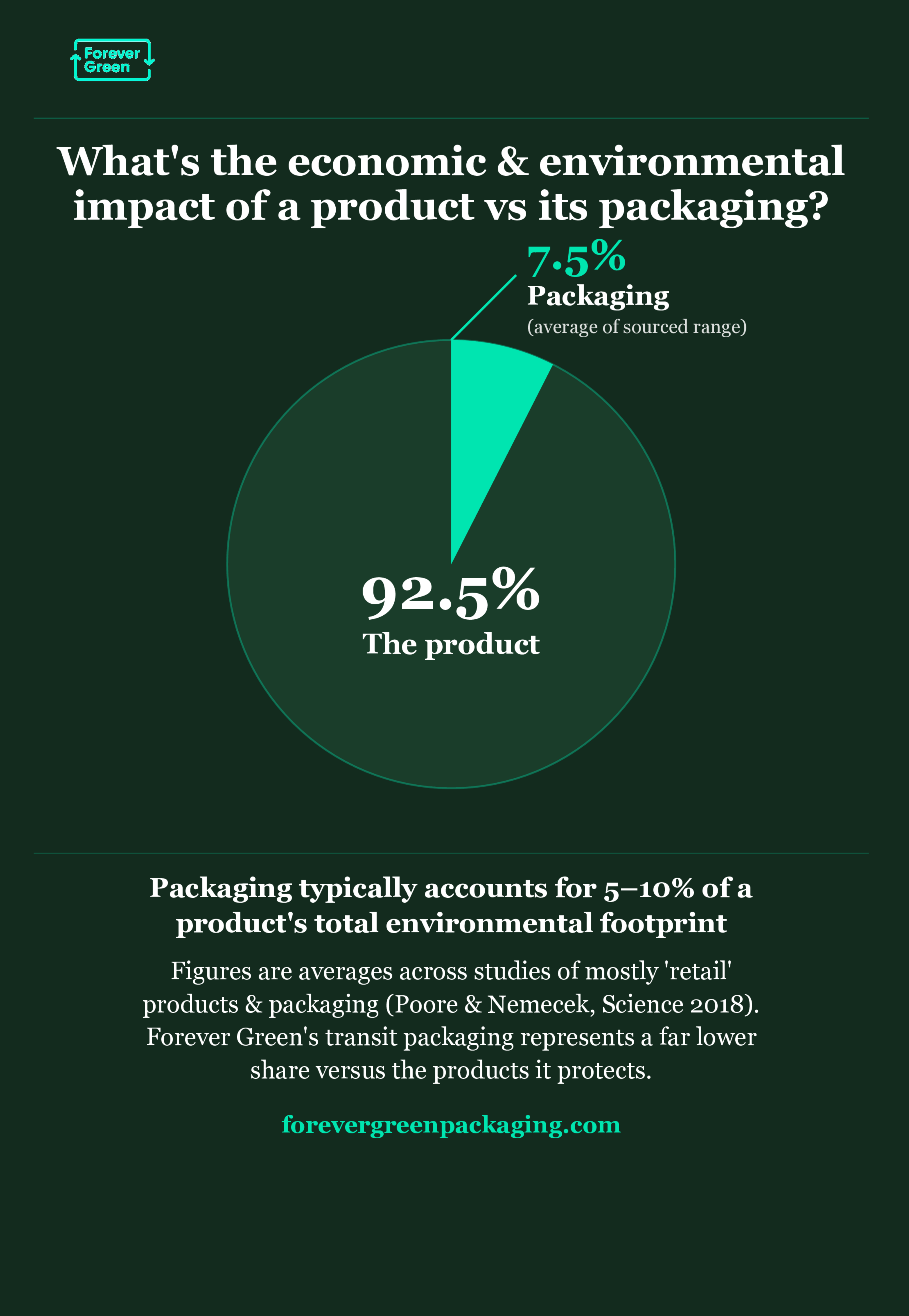
Packaging - the unsung hero
The chart illustrates this difference between the amount of raw materials, energy, water, labour, and supply chain involved in making a product vs its packaging.
The economic and environmental cost of correct packaging is very low compared to the very high economic & environmental cost of making the product. The 1st saves or protects the 2nd. This simple comparison is worth delving in to, before Part 2 which looks at the domino effects of a damaged product.
The comparison of course varies depending on the type of product and packaging. This is an important distinction because the numbers in the chart come from studies, including Poore & Nemecek'slandmark 2018 study in Science, which are based mostly on ‘retail’ packaging.
As interesting and illustrative these numbers are, the difference is far larger in the case of ‘transit’ packaging like Forever Green’s, and the typical products they protect. There are no official statistics to be found on transit packaging, unlike retail packaging, but here are some reasonable assumptions which support the claim that transit packaging has an even lower impact vs the actual prodcut.
With so many food and drink products constantly being made and consumed, we can assume these contribute largely to the retail figures. In these cases, the product will have relatively low material value, a drink for example is majority water, and its primary retail packaging will be branded with more manufacturing process.
Let’s compare this to Electronics, like a laptop in its primary retail packaging. Collectively the laptop and its primary packaging represent the higher end of environmental and economic costs to make. Yet the protective outer packaging needed to protect it in transit, such as protective materials like air cushion bubble or quilt material, padded paper, or foam, would represent the lower end of impact of packaging materials. This type of packaging has far fewer processes from raw material to finished product than retail packaging. And a smaller supply chain.
Therefore, in this laptop case we can reasonably assume the economic & environmental impact of making the right amount of protective packaging is possibly way less than 1% of the equivalent impact to make the laptop.
Generally speaking, the split gets bigger for more fragile and higher-value items vs their protective packaging. Electronics are dominated by what's called embodied carbon. This is the manufacturing footprint locked in before the product ever ships. For a smartphone or smartwatch, embodied carbon runs to 80–85% of its entire lifetime footprint. For a laptop, 70–75%. And that's before counting the retail packaging each item already arrived in, which have their own box, printing, manufacturing footprint. The things being protected are, environmentally speaking, almost the whole story. The protection/ void fill added around them is a footnote.
There are honest exceptions, where the above logic works in reverse, such as perfumes or drinks. This is where their ‘retail’ packaging sometimes reaches 40–65% of total impact. If we look at why, a bottle of wine is mostly water which is a low-impact product. But often it’s wrapped in heavy glass, foil, and presentation packaging that also exists to signal brand positioning and price. This is a different category of packaging solving a different problem.
When it comes to packaging whose primary purpose is to protect, the emphasis should be more has it worked, and less what the material is. Forever Green help customers use materials with lowest overall impact, and as little of them as possible, within the overriding modus operandi of ‘does it work’.
The protective packaging is almost nothing next to what it's protecting. And when done right, everyone will assume the packaging has done nothing!
Part 2 explores the noise of everything that happens when packaging is not done right.
References: numbers in graph are average across multiple independent sources and studies, including Poore & Nemecek's landmark 2018 study in Science, one of the most widely cited pieces of life-cycle research in the field. Environmental cost of product returns and remanufacturing: general lifecycle analysis principles; protection performance of void fill systems: FGP internal expertise and product documentation. The argument that packaging protection performance is a lifecycle environmental consideration is consistent with ISO 14044 lifecycle assessment methodology.
