


There's a line from Futurama worth borrowing: "When you do things right, people won't be sure you've done anything at all." Packaging lives by that rule more than most things. Nobody remembers the box that did its job. But get it wrong, and everyone will be very sure you've done something, because now there's a cracked TV, an angry customer, and a problem that doesn't end with a bad review.
Going back to the scenario: the TV arrives damaged. The customer is obvioulsy disappointed so berates the packaging, or the sender, has the hassle of returning or disposing, then moves on with their day. But for the business on the other end, that's where the real story starts. The graphic illustrates the cascading effects of failed packaging and the numerous people involved who soon know about it.
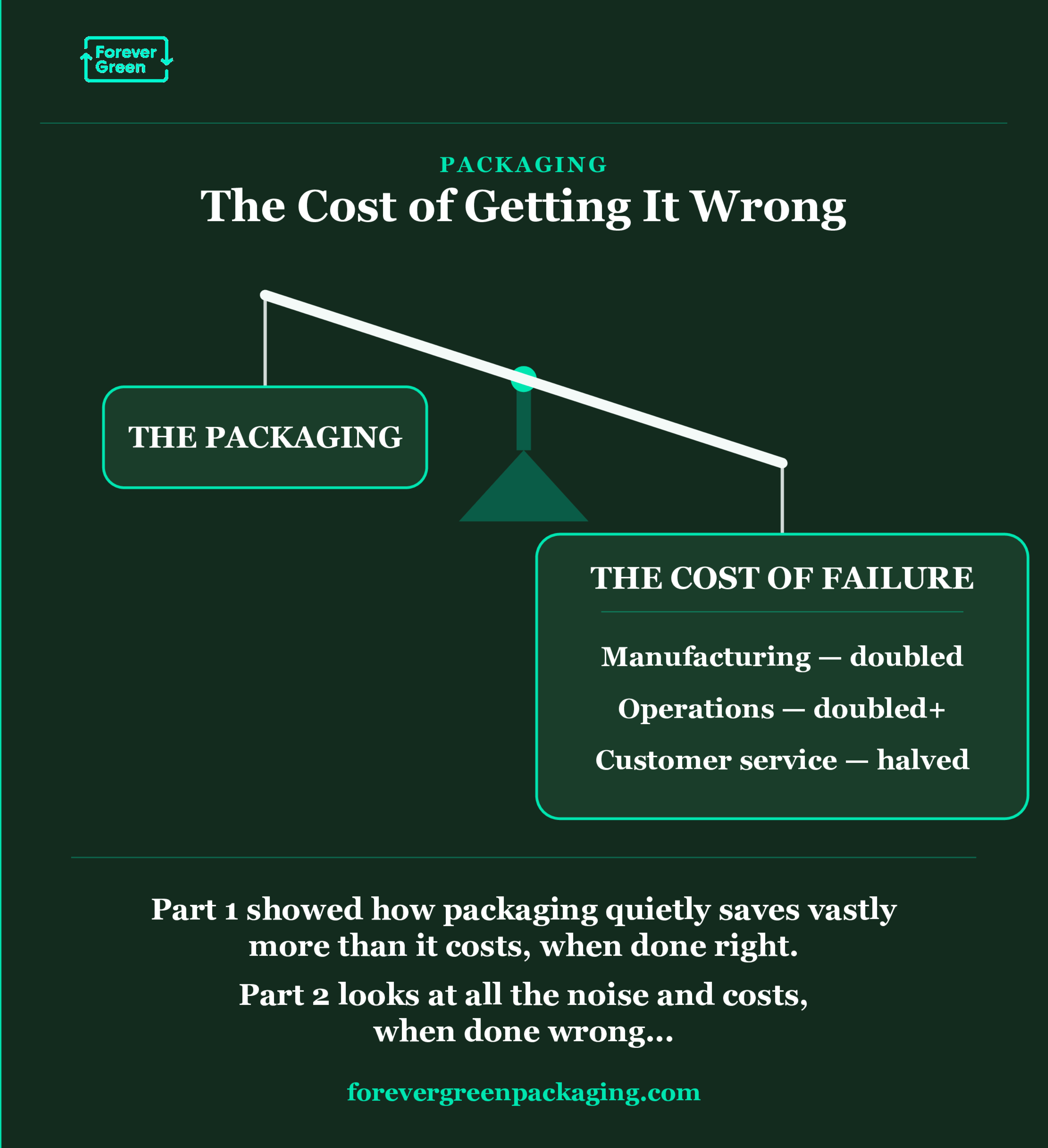
Manufacturing — doubled.
A cracked TV isn't a TV with a scratch. It's a product that has to be remanufactured or written off/ disposed entirely. Either way, a second one has to be built, using a second full round of the raw materials, energy, water, labour, wide supply chain and logistics that went into the first. Part 1 showed that the product is where the real footprint lives, not the packaging. Getting the protection wrong doesn't put a small footprint at risk, it puts the large one at risk, twice. And of course double the packaging, although that's a fraction of the impact of the product.
Operations — doubled, and then some.
A damaged item doesn't just need remaking, packing and sending again. It's not just a duplicate of what should have happened properly the first time. It also needs collecting, assessing, processing as a return, restocking or writing off, and then replacing — a second pick, a second pack, a second delivery, a second set of transport emissions, for what should have been one transaction, plus the additional operational cost of solving the damaged product. This effectively more than doubles the cost of sales, hence significantly reduces or wipes out the profit of the 1st order, if not costs more overall than the original profit.
The industry backs this up. Sealed Air, a major manufacturer in the protective packaging space, has found that even at a damage rate most operations would consider excellent — just 1% — the environmental impact of that damage can account for 48% of a shipment's total environmental cost. The precise mechanics behind that figure aren't fully published, but the scale of it lands where our argument predicts: a small number of failures, driving a wildly disproportionate share of the total impact.
Customer service — halved.
Reputation is arguably a business' most valuable asset. Not guarded properly, it's like a silent assasin invisible on the profit & loss spreadsheet. A customer who receives a damaged product doesn't just want a replacement. They want reassurance that it won't happen again, and plenty of them might consider the effort not worth it, especially with the online competition. Trust once compromised is expensive to rebuild. The hassle of a return, the delay of a replacement, the quiet decision to order from somewhere else next time. These translate to the most real numbers to a business: repeat orders, word of mouth, reviews, referrals, and margin.
With manufacturing doubled, operations doubled+, customer trust halved, the picture is clear that protecting products properly also protects the environment and your business. Environmental cost and business cost are one and the same. Not wasting what's already been made, not to mention the big sales & marketing effort to give the product a life at all, is a priority for businesses that Forever Green takes pleasure to support.
Circling back to Part, packaging, especially protective transit packaging, is almost nothing next to what it's protecting. The goal is for the product to arrive exactly as it left, which is the ultimate customer impression. This can be achieved in many ways. But achieving it with the lowest impact materials, using as little as possible, in a way supporting the efficiency of a customer's unique operational ecosystem, is the Forever Green way :)
References: Sealed Air, sustainability content on e-commerce fulfilment. The argument that packaging protection performance is a lifecycle environmental consideration is consistent with ISO 14044 lifecycle assessment methodology.
